
Inflation shock on the way
There is a nasty inflation shock on the war. High energy prices are now spreading down the value chain and hitting things like plastics, it will reach Central Banks interest rate decisions soon.

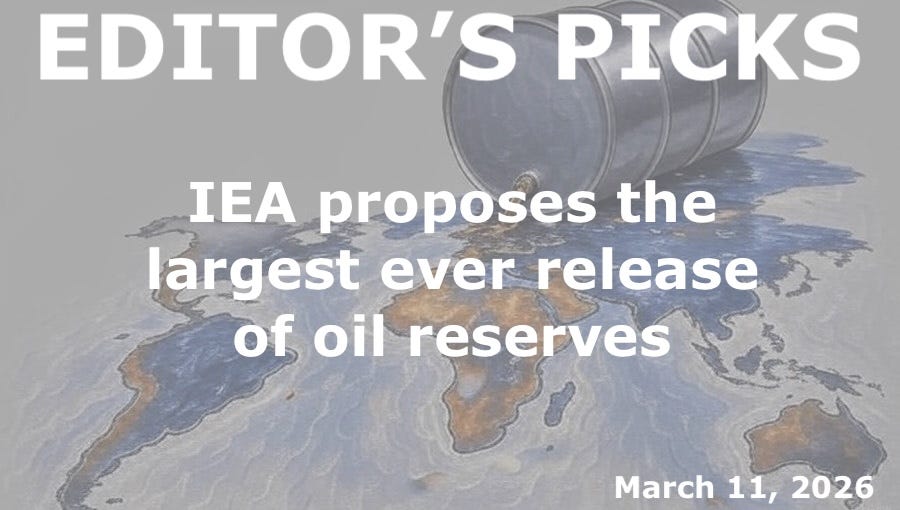
Day 11: You can watch this crisis-virus ripple out in real time. It started with “Wild Monday” this week and the seesawing of oil prices. Today they’ve settled down at around $87 after international institutions moved to calm the markets.
The IEA just announced it is calling for the biggest ever release of oil from reserves and the oil futures price immediately fell after the announcement was made. But it’s not a done deal and to be honest it’s only going to bring temporary relief. It looks more like a panic reaction to spiking prices as the basic problem that the Persian Gulf is still bottled up has not been solved – and won’t be any time soon.
To get a sense of what’s really going on Russia’s Urals blend is still trading at over $100 this morning -- a $13 premium to Brent for the first time ever (bar a few odd days here and there. In the good old days of peace before all these wars started, Urals classically traded at a $2 discount to Brent. This premium is not an aberration, but a structural change as now it’s the only oil that you can get without having to sail down sniper’s alley. Obviously, Russian oil is a lot more attractive than trying to sneak a tanker through the Straits of Hormuz.
On that score we had a piece saying a few Greek tankers are slipping through and at least one Chinese tanker has tried running the gauntlet. This will be interesting as one of Trump’s war goals appears to be to get Iran to abandon its navy – reportedly Special Envoy Steve Witkoff demanded this in the Geneva talks the day before Operation Epic Fury started – and take complete control of the Straits.
If Iran hangs onto the Straits (my basic scenario assumption) then it could be that the only transit passes Tehran will hand out will be to its “friendly countries.” Tehran will effectively turn the tables on the US with what de facto oil sanctions on the US and its allies. As a major oil producer, the US would survive that but Europe would not.
Iran is already letting a few of its own tankers through, but the Straits aren’t going to be opened anytime soon. Despite Trump’s bluster, as we’ve pointed out from the beginning, the US Navy is incapable of protecting tankers. In the classic mistake the US generals have armed themselves for the last war and are completely helpless against Iran’s swarms of modern drones.
That’s pretty remarkable. It’s a testament to just how badly prepared the US military is. Its flagship USS Gerald Ford is currently moored off Haifa in Israel far, far away from the action and has no intention of going anywhere near the Straits. This is the big version of the cost-to-kill ratio advantage Iran has over America in this war that
will win it for them. The USS Gerald Ford is so expensive it simply can’t be
used.
Despite all the cool tech surveillance and high-powered weaponry these ships carry, they are still unable to spot a mine three meters below sea level, which can blow a big hole in the side of even the best US warship.
As the Gulf economies are so lopsided, as the financial pressures build at some point you’d assume they will take matters into their own hands, but that would be the next level, and we’d be flirting with WWIII at that point.
What this means is that the US has actually lost control of the situation. CENTCOM needs to deliver a knock-out blow, and do it in the next few weeks, or it will suffer a strategic defeat. But now the IRGC has triggered its Decentralized Mosaic Defence doctrine (DMD) . I have no confidence it will be able to do
that. All the IRGC needs to do is hang in there for another six weeks or so and
the crisis-virus and a lack of money and missiles will put the US military
campaign in hospital on a respirator.
You can already see the crisis-virus spreading down the value chains. I wrote a large piece about the inflation shock that is on the way.
The sky-high energy prices are feeding into pretty much every walk of life. Dubai’s supermarkets will run out of fresh fruit and veg by the end of this week as a good example of how this works. Much more serious is SE Asia plastics producers starting to feel the effects as obviously gas is the major feedstock in petrochemicals.
From the #2026oilshock spreads out and stock markets and bonds are also starting to feel the pain. Less reported than the oil price gyrations this week, debt markets have also been walloped which will put pressure on central banks around the world to hike rates, including the Fed.
The surge in inflation is going to do widespread damage to the global economy as many markets that were intending to cut rates this year to boost growth are now going to have to hike. (That sudden flipping of expectations on rate cuts is what is doing so much damage so quickly to bond markets.) The only person that seems to be having a good time is Putin who held the cabinet meeting yesterday to discuss Russia’s energy plans. He’s cranking up the European gas crisis by turning the tables on Europe and proposing to ban Russian LNG exports to the EU immediately at a time when the tanks are at record lows as the refilling season starts.
Europe’s energy crisis is going to go on all summer as prices soar and then become acute when the heating starts in November as they simply won’t have enough gas in the tanks by then. Going back to coal is one of the few options open for alternative energy supplies. Germany’s decision to blow up its six huge and extremely efficient nuclear power stations is now looking suicidal.
There are still plenty of red lines left to cross. There is an increasing, albeit low, number of attacks on Gulf oil production facilities and infrastructure. Bahrain is in the front line here, both in terms of attacks and economic instability.
Iran’s vulnerability is the Khang Island that is responsible for 90% of Iran’s exports. If
it gets destroyed that locks in the energy crisis for several years and will
spark a full-blown regional war. None of Iran’s neighbours will go there, but
Israel might.
Another red line is to hit the desalinization plants but again everyone is holding back on that because if it happens then you’d have to depopulate the entire Persian Gulf region. There is no fresh water in the Gulf.
I think these are the nuclear options that the IRGC are holding in reserve in case they actually look like they might lose the war. The new supreme leader is from the IRGC faction and presumably as fanatical as they are. My working assumption is they would rather destroy everything then concede to US rule.
The liberals in the government, like Iranian President Masoud Pezeshkian and Iranian Foreign Minister Abbas Araghchi, have lost all of their influence, who might have been willing to do a deal. By bombing the crap out of the country, any chance of a negotiated solution is off the table for the meantime. Araghchi said exactly this two days ago. The mentality is now “death or glory.” Don’t forget in Islamic culture martyrdom is an honourable solution to your worst problems.
US envoy Steve Witkoff reportedly made an approach to Tehran to see if there was any interest in starting ceasefire talks. He was told to get knotted. It seems the IRGC don’t agree with Trump’s assessment that the war is “pretty much over.”
This article originally appeared in Editor’s Picks, a free daily email digest of bne IntelliNews’ best stories from the last 24 hours. Sign up for free here.
https://to989.infusionsoft.com/app/form/editors-picks-subscribers