
EU expansion gathering steam
The EC released its accession progress report yesterday and everyone is making good progress, except Georgia which got an F.

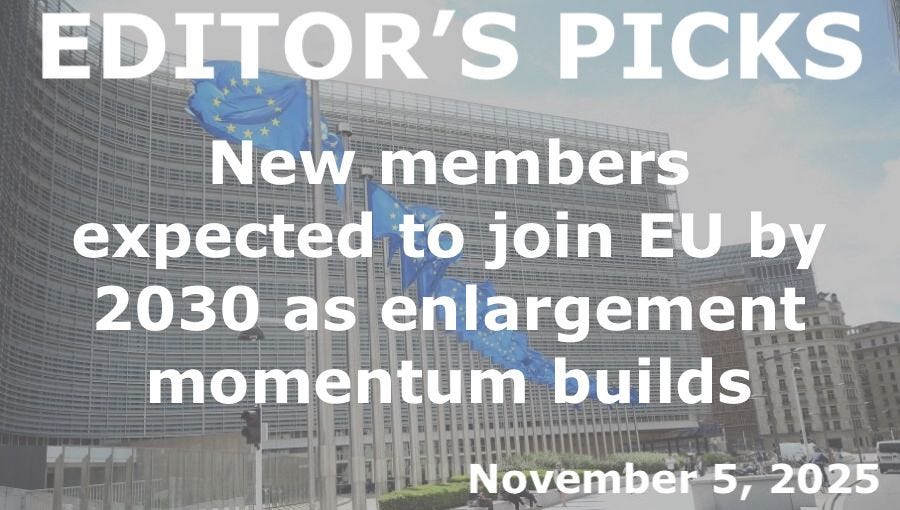
It was always going to take a long time, but the EU expansion keeps plugging forward. The European Commission (EC) emission released its progress report yesterday and gave top marks to the Balkans and Moldova. Ukraine got a downgrade from A+ to B. Turkey was included in the assessment, but that is just because after 26 years in the waiting room everyone continues to pretend it is actually a candidate. And Georgia was bluntly told it is now a candidate “in name only.”
For the best part of the last three decades, the best post-socialist experiment reform strategy was simply “join the EU.” It worked brilliantly, not just because of the huge structural transformation grants, but also because countries got fully formed and functioning institutions as part of the package. It’s a bit of a geeky point, but personally, I believe the institutions are more important than the money. Plus, access to a huge 450mn-strong rich consumer market doesn’t hurt either.
But that is now changing. The EU is in decline. The standard of living is falling. And industry is leaving to go where energy is cheaper and raw materials are more plentiful. Still, if you are a Moldova or a Ukraine you still want to join, simply to get rid of those import tariffs and tap some of the grant aid.
Now there is a new dimension of political disunity, manifest by Hungary, but not only, that is making Brussels increasingly dysfunctional. The likes of European Commission President Ursula von der Leyen and EU foreign policy chief Kaja Kallas are grappling with these problems, as in reality the EU only works well in the good times when consensus building is a good system and badly in crises when you need strong top-down leadership.
That’s the basic flaw with the EU: it remains a trade club, not a federation like the US. All the big problems the EU faces, from funding the war in Ukraine to investing into improving its competitiveness, can’t be solved as long as every single one of its 27 members have to agree. The talk of ending the unanimity rule will go nowhere as it only takes one veto by a small country to shoot it down. As a result it has become ossified and as a result will fade as it is unable to respond to these challenges. This comes at a time when the Global South is rising fast, which has already changed the face of the global economy.
Still, not counting Turkey and Georgia, in the short-term all the candidate countries are making good progress. I did a deep dive into Ukraine which is very keen to join, which considering it is in a war has made real progress. However, the key problems of endemic corruption and almost no progress on judicial reforms is holding it back.
These failures are more important than they might seem as the investors I speak to – the people that actually have the billions of dollars that Ukraine needs to rebuild – are pretty universal in their concern with the lack of solid property rights and working contracts. They say they won’t invest until these things are fixed and proven to work.
Given that Pokrovsk looks very likely to fall to Russia, all this might become very relevant very soon. Happily, the widely quoted World Bank estimate of some $526bn of total damage is not the actual number as all the worst damaged cities are in the occupied regions in the east and under Russia’s control, who will end up being responsible for paying them to be fixed – another financial problem for the increasingly cash-strapped Kremlin.
The remaining 80% of the country under Bankova’s control is much better off and the damage bill there is around $200bn at a very rough estimate. Given the International Financial Institutions (IFIs) has around $75bn worth of programmes earmarked for Ukraine, according to Peterson Institute for International Economics (PIIE), then funding the rebuild starts to look much more doable, even if the private fund managers move slowly. Ukraine has a total of $20bn in outstanding Eurobonds and another $6bn in the local OVDP bonds and presumably can raise this again – which is about half of what is needed for reconstruction.
The key will be to get to critical mass that allows a virtuous circle of investment-growth-profits-wages to start turning which we saw in Russia in about 2001- something few acknowledge now. Then Ukraine will boom. It has all its catch-up growth ahead of it still, one of the few FSU countries for which that is still true. (Central Asia is going through exactly this now.)
The bug in the ointment is there is very likely to be a nasty political crisis after the war ends as many will blame Zelenskiy for the failure. Still, the EU will throw everything into keeping Ukraine on the European path like it did in the recent Romania and Moldovan elections which were frankly rigged to make sure the Eu-agenda parties got into power – another thing few are prepared to acknowledge.
These problems are already manifest. While Ukraine was praised for its progress, European Commissioner for Enlargement Marta Kos and others made it perfectly plain that they were unhappy with Zelenskiy’s growing authoritarian tendencies and have suggested a probation period for new members. More obviously is Georgia’s complete capture by oligarch Bidzina Ivanishvili after it was the poster boy for change under Saakashvili, who has also been completely discredited since and is now in jail on corruption charges. Orban gets a lot of flak, but the rise of the far-right across all of Europe is clearly also going to undermine the EU mission. Trump has already left the values-party and gone totally transactional. So, the whole EU programme is looking a lot less appealing than it used to only a few years ago.
Still, all this is highly uncertain, especially given Europe’s disunity and rapidly decaying economic situation. Anything could happen.
This article originally appeared in Editor’s Picks, a free daily email digest of bne IntelliNews’ best stories from the last 24 hours. Sign up for free here.
https://to989.infusionsoft.com/app/form/editors-picks-subscribers